Moringa Articles
Moringa Powder for Bakery Products: A Natural Ingredient Opportunity for Value-Added Formulations
September 24, 2026
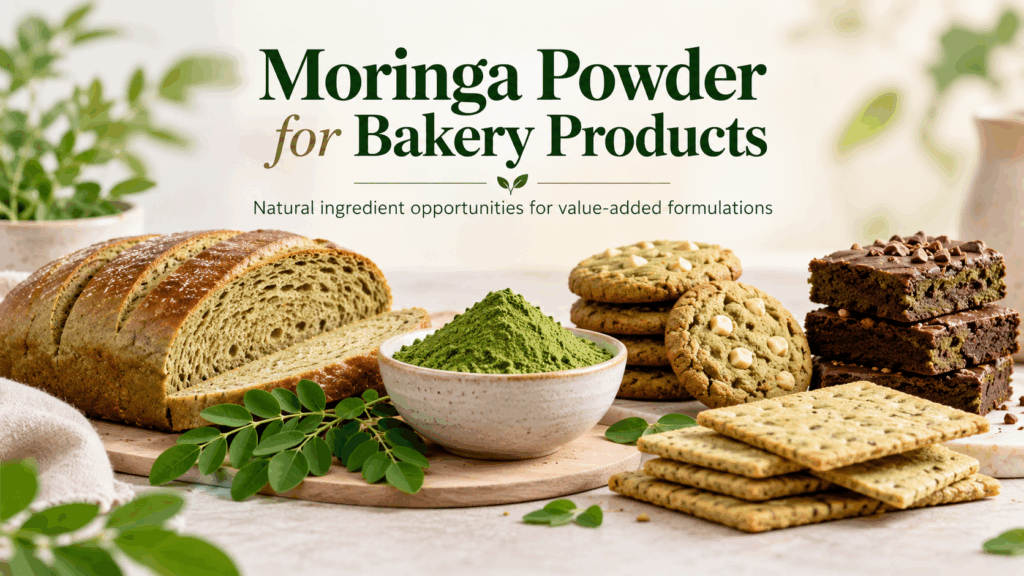
The bakery industry continues to evolve as consumers show growing interest in products made with plant-based ingredients and with more attractive nutritional profiles. For bakery manufacturers, brand owners, and R&D teams, the challenge is not only to find ingredients with added value, but also to ensure they remain compatible with the final product’s taste, color, texture, and overall sensory profile.
One ingredient that has been widely explored in research is Moringa oleifera powder, particularly powder made from moringa leaves.
A scientific review published in Plants examined multiple studies on the use of Moringa oleifera in bakery products, including bread, cookies, brownies, rice crackers, and snacks.
Why Is Moringa Powder Interesting for the Bakery Industry?
Moringa leaves contain a range of nutrients and bioactive compounds. The review describes moringa as containing proteins, essential amino acids, fiber, vitamins, minerals, phenolic compounds, and other phytochemicals.
The nutritional composition summarized in the study shows that dried moringa leaves may contain approximately 19–27.1% protein and 7.9–19.2% fiber, although composition can vary depending on growing conditions, maturity, location, and post-harvest processing.
From a product development perspective, these characteristics make moringa powder an interesting ingredient for bakery fortification and formulation innovation.
The application diagram shown on page 7 of the review highlights moringa use in several bakery categories, including cookies, bread, brownies, rice crackers, and snacks.
This means its application potential extends beyond a single bakery category.
Moringa Powder in Cookies
Cookies are among the most frequently studied bakery products for moringa application.
One study summarized in the review found that replacing part of the wheat flour with 10% moringa leaf flour maintained acceptable sensory characteristics, while consumer acceptability generally decreased as the proportion of moringa increased further.
Another study tested moringa leaf and seed powders at concentrations of 2.5%, 5%, and 7.5%. The results showed higher levels of protein, fiber, ash, and minerals in the fortified cookies. The researchers concluded that around 5% incorporation improved nutritional characteristics without significantly compromising organoleptic quality.
For bakery R&D teams, this type of result can serve as a useful starting point for formulation trials, rather than a fixed formula. Flour type, sweeteners, fat systems, flavorings, and baking conditions will still influence the final result.
What About Bread?
Similar potential has also been observed in bread applications.
Research on whole wheat bread tested moringa leaf powder at 5%, 10%, 15%, and 20%. The addition increased protein, ash, and mineral content, but product acceptability decreased as moringa concentration increased, especially at the higher inclusion levels.
The researchers identified 5–10% incorporation as a more suitable range for balancing nutritional improvement with acceptable sensory characteristics.
This is an important consideration for commercial product development.
Using more functional ingredients does not automatically create a better product. Formulation still needs to balance nutritional positioning with taste, texture, appearance, and consumer acceptance.
Brownies, Cakes, and Stronger-Flavored Products
Moringa has also been studied in brownies.
One study incorporated 5% and 10% moringa leaf flour into chocolate brownies. The fortified samples showed higher ash content and lower lipid content compared with the control, while the researchers reported no major difference between the 5% and 10% formulations for the evaluated parameters.
Products such as brownies may be particularly interesting for formulation trials because ingredients such as cocoa, chocolate, sweeteners, and other flavor systems can be used to balance the natural sensory characteristics of moringa.
Potential product concepts include:
- Moringa chocolate cookies
- Moringa oat cookies
- Moringa whole wheat bread
- Moringa brownies
- Moringa crackers
- Plant-based bakery snacks
Moringa in Rice Crackers and Snacks
Moringa applications are not limited to wheat-based bakery products.
In rice crackers, formulations containing 1%, 2%, and 5% moringa leaves were evaluated. According to the review, the 1% and 2% formulations had higher levels of β-carotene, vitamin C, and calcium than the control, while sensory scores remained comparable to the control even at the end of the storage test.
The review also reports that moringa leaf powder used in snack products increased protein and fiber content while flavonoids were still found in the final product.
For manufacturers, this creates opportunities not only in conventional bakery products but also in healthy snacks, functional snacks, and plant-based product concepts.
The Main Challenge: Finding the Right Formulation Balance
One of the most important conclusions from the research is that higher moringa inclusion levels can affect product characteristics such as:
color, taste, texture, volume, aroma, and overall acceptability.
The review concludes that moringa incorporation can improve the contribution of proteins, fiber, vitamins, and minerals, but high concentrations may alter the physical and sensory characteristics of the finished product.
For this reason, commercial development should not begin with the question:
“How much moringa can we add?”
A more useful question is:
“What moringa concentration delivers added value while maintaining the sensory profile consumers expect?”
This is where formulation trials, sensory evaluation, and ingredient selection become essential.
Opportunities for Bakery Manufacturers and Brand Owners
Based on the studies reviewed, moringa powder can be explored by companies developing products positioned around concepts such as plant-based ingredients, natural ingredients, nutrient-enriched bakery products, functional foods, healthy snacking, or naturally green product concepts.
However, each product requires its own formulation strategy.
The concentration that works well in bread may not be ideal for cookies, while a level suitable for crackers may perform differently in cakes or brownies.
The review also emphasizes the importance of technological, nutritional, and sensory development, as well as the need for further research on the stability and bioavailability of nutrients and bioactive compounds after processing.
Develop Your Bakery Products with MORIFA
Are you developing cookies, bread, brownies, crackers, snacks, or other bakery products with Moringa Powder?
MORIFA supplies Moringa Powder for B2B ingredient applications and product development needs.
Discuss your product concept, required quantity, and ingredient specifications with our team.
Develop your bakery products with MORIFA.
Contact Us for product information, samples, specifications, and a quotation.
Journal source: Health Benefits of Uses and Applications of Moringa oleifera in
Bakery Products